
 By
By How Air Quality Data Improves Weather Prediction for Crop Safety
Weather forecasting has always played a crucial role in agriculture. Farmers rely on accurate predictions to make decisions about planting, irrigation, fertilisation, and harvesting.
However, traditional weather forecasts mainly focus on temperature, rainfall, humidity, and wind conditions. Today, air quality data is becoming an increasingly valuable addition to weather prediction models, helping farmers better protect crops from environmental stress and potential damage.
Air quality data refers to information about the concentration of pollutants and particles in the atmosphere. These pollutants can include ozone, nitrogen oxides, sulphur dioxide, and particulate matter such as dust or smoke. While air quality is often discussed in relation to human health, it also has a significant impact on plant growth and crop productivity. By integrating air quality data with weather forecasts, agricultural monitoring systems can provide more accurate insights into environmental conditions that affect crops.
One of the most important pollutants affecting crops is ground-level ozone. This gas forms when sunlight reacts with pollutants emitted by vehicles, industry, and other sources. High levels of ozone can damage plant tissues, interfere with photosynthesis, and slow crop development. When weather prediction models include air quality data, farmers can receive early warnings about conditions that may lead to elevated ozone levels. This allows them to take preventive measures, such as adjusting irrigation schedules or protecting sensitive crops during critical growth stages.
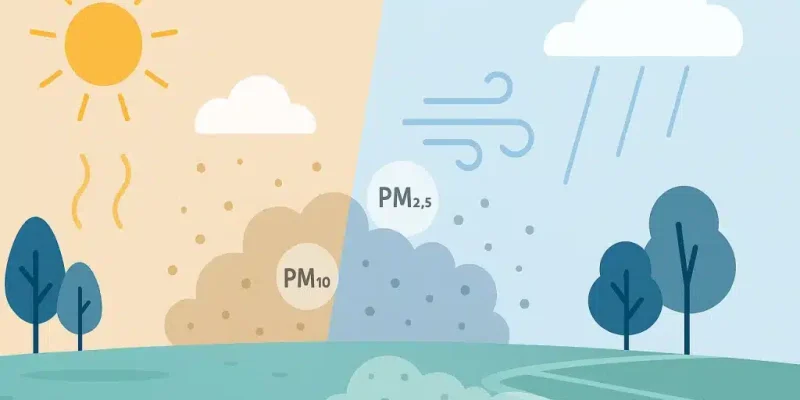
Another important factor is particulate matter, which includes tiny airborne particles like dust, smoke, and industrial emissions. These particles can settle on plant leaves and reduce the amount of sunlight that reaches them. In some cases, particulate matter may also carry harmful chemicals that affect soil quality and plant health. Monitoring air quality data alongside weather patterns helps farmers anticipate periods when particulate levels may increase due to wind patterns, nearby fires, or industrial activity.
Weather conditions strongly influence how pollutants behave in the atmosphere. Temperature, wind speed, humidity, and atmospheric pressure all affect how pollutants form, disperse, or accumulate. For example, calm winds can cause pollutants to build up near the ground, while strong winds may transport pollutants across large distances. By combining meteorological data with air quality data, weather prediction models can better estimate when and where pollution levels may rise, giving farmers more reliable forecasts.
Advances in environmental monitoring technology have made it easier to collect and analyse air quality data. Modern monitoring systems use sensor networks, satellite observations, and ground-based stations to measure pollutant levels in real time. This data can then be integrated into advanced forecasting models that help identify environmental risks for agriculture.
For farmers, access to this information can support more informed decision-making. If forecasts indicate poor air quality conditions during sensitive crop growth periods, farmers may adjust planting times, implement protective irrigation strategies, or monitor crops more closely for signs of stress. In greenhouse farming, ventilation systems can also be managed to reduce exposure to polluted air.
Beyond short-term protection, long-term air quality data can also help farmers identify environmental trends that influence crop planning. By understanding how air pollution interacts with weather conditions over time, farmers can select crop varieties better suited to local environmental conditions.
As environmental monitoring technologies continue to improve, the integration of air quality data into weather prediction models will become increasingly important. By providing deeper insights into atmospheric conditions, this data helps farmers reduce risks, protect crop health, and support more sustainable agricultural practices.